Die Vergleichsanalyse :
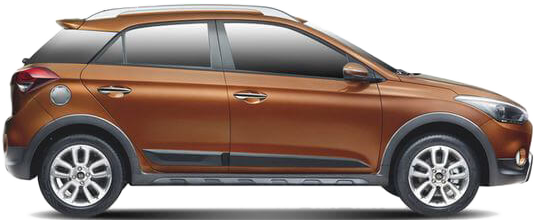
Hyundai i20 Active 1.4 (18 - 18) vs. Ford Fiesta 1.1 (19 - ..)
18.800 €
13.500 €

18.800 €
Grundpreis ⓘListenpreis für das Basismodell (Standardausstattung ohne Extras) zum Zeitpunkt der Markteinführung in Deutschland.
13.500 €
ⓘListenpreis für das Basismodell (Standardausstattung ohne Extras) zum Zeitpunkt der Markteinführung in Deutschland. Preisinfo

Abmessungen
Der Hyundai i20 Active 1.4 ist etwas größer. Er ist 2.5 cm länger, 2.5 cm breiter und 5.3 cm höher als der Ford Fiesta 1.1 Start/Stopp.
Hyundai i20 Active 1.4
Ford Fiesta 1.1 Start/Stopp
1529

1760
1980
1476

1735
1941
1760 mm
Breite
1735 mm
1980 mm
Breite mit Spiegeln
1941 mm
1529 mm
Höhe
1476 mm

2570
4065

2493
4040
4065 mm
Länge
4040 mm
2570 mm
Radstand
2493 mm
Gewicht
Hyundai i20 Active 1.4
Ford Fiesta 1.1 Start/Stopp
1085 kg
Leergewicht
1108 kg
1600 kg
Zulässiges
Gesamtgewicht
1615 kg
Gewichtsdifferenz:
23 kg
2.08 %

Allgemein
Hyundai i20 Active 1.4
Ford Fiesta 1.1 Start/Stopp
GB
Baureihe
JHH
Schrägheck
Karosserie
Schrägheck
Super (ROZ 95)
Kraftstoff
Super (ROZ 95)

Frontantrieb
Antrieb
Frontantrieb
6-Gang-Schaltgetriebe
Getriebe
5-Gang-Schaltgetriebe
Motor
Hyundai i20 Active 1.4
Ford Fiesta 1.1 Start/Stopp
Reihenvierzylinder-Benziner (Saugmotor)
Motorbauart
Reihendreizylinder-Benziner (Saugmotor)
4
Ventile
4
4
Zylinder
3
1368 cm³
Hubraum
1084 cm³
100 PS
bei 6000 U/min
Leistung
75 PS
bei 5500 U/min
Hyundai i20 Active 1.4
100 PS
75 PS
Ford Fiesta 1.1 Start/Stopp
134 Nm
bei 3500 U/min
Drehmoment
105 Nm
bei 3500 U/min
Hyundai i20 Active 1.4
134 Nm
105 Nm
Ford Fiesta 1.1 Start/Stopp
Leistungsfähigkeit
Hyundai i20 Active 1.4
Ford Fiesta 1.1 Start/Stopp
178 km/h
Höchstgeschwindigkeit
165 km/h
11.9 s
Beschleunigung 0 – 100 km/h
14.5 s
100 km/h
100
km/h
165 m
0.000 s

Hyundai i20 Active 1.4
100 km/h
100
km/h
201 m
0.000 s

Ford Fiesta 1.1 Start/Stopp
▶ REPLAY
10.85 kg/PS
Leistungsgewicht
14.77 kg/PS
Hyundai i20 Active 1.4
10.85 kg/PS
14.77 kg/PS
Ford Fiesta 1.1 Start/Stopp
Verbrauch / Umwelt
Hyundai i20 Active 1.4
Ford Fiesta 1.1 Start/Stopp
Verbrauch pro 100 km
5.7 L
kombiniert
4.5 L
Hyundai i20 Active 1.4
5.7 L
4.5 L
Ford Fiesta 1.1 Start/Stopp
7.4 L
innerorts
5.4 L
4.7 L
außerorts
4 L

50 L
Tankgröße
42 L
877 km
Reichweite
933 km
Hyundai i20 Active 1.4
877 km
933 km
Ford Fiesta 1.1 Start/Stopp
Auswirkung auf die Umwelt
67.1 kWh
Gesamtenergieverbrauch
pro 100 km ⓘDer Gesamtenergieverbrauch pro 100 km ergibt sich aus der Energie, die ein Fahrzeug bei der Verbrennung eines Treibstoffs (bzw. bei der Verwendung von Strom) pro 100 km verbraucht (Endenergie) und der Energie, die für die Erzeugung und Bereitstellung entsprechender Menge Treibstoffs (bzw. Stroms) benötigt wird (Primärenergie). Dabei werden auch die Vorprozesse der Treibstoffherstellung, der Transport eines Treibstoffs bis zur Tankstelle (bzw. der Transport des Stroms bis zur Steckdose) und die Verluste, die dabei auftreten, berücksichtigt. Der Gesamtenergieverbrauch ermöglicht somit einen Vergleich der Energieeffizienz von Fahrzeugen mit verschiedenen Antriebssystemen.
53 kWh
Hyundai i20 Active 1.4
67.1 kWh
53 kWh
Ford Fiesta 1.1 Start/Stopp
Euro 6b (NEFZ)
Schadstoffklasse
Euro 6d-TEMP-EVAP-ISC (WLTP) 36CH, 36CI, 36DG
133 g/km (NEFZ)
CO2-Emissionen
134 g/km (WLTP)
Alltagsnutzen
Hyundai i20 Active 1.4
Ford Fiesta 1.1 Start/Stopp
5
Türen
3
5
Sitzplätze
5
515 kg
Maximale Zuladung
507 kg
326 L
Kofferraumvolumen
292 L


1042 L
Stauraum mit umgeklappter
Rücksitzbank
1093 L