The Comparative Analysis :
Hyundai i30 N (17 - 19) vs. Volvo V40 D2 (12 - 15)
€ 29,700
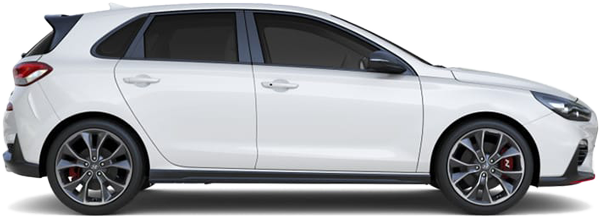
€ 25,500

€ 29,700
Base Price ⓘBase price of a new vehicle with standard equipment in Germany at market launch.
€ 25,500
ⓘBase price of a new vehicle with standard equipment in Germany at market launch. Price Info

Vehicle Dimensions
The dimensions of these vehicles differ a little. The Hyundai i30 N is 3.4 cm shorter, 1.2 cm wider and 3.1 cm taller than the Volvo V40 D2.
Hyundai i30 N
Volvo V40 D2
1451

1795
2050
1420

1783
2041
1795 mm
Width
1783 mm
2050 mm
Width Incl. Mirrors
2041 mm
1451 mm
Height
1420 mm

2650
4335

2647
4369
4335 mm
Length
4369 mm
2650 mm
Wheelbase
2647 mm
Vehicle Weight
Hyundai i30 N
Volvo V40 D2
1475 kg
Kerb Weight
1471 kg
1950 kg
Gross Vehicle
Weight
Weight
1890 kg
Weight Difference:
4 kg
0.27 %

General
Hyundai i30 N
Volvo V40 D2
PDE
Generation
M
Hatchback
Car Body Style
Hatchback
Unleaded (95 RON)
Fuel Type
Diesel

Front-wheel drive
Drive
Front-wheel drive
6-speed manual transmission
Transmission
6-speed manual transmission
Engine
Hyundai i30 N
Volvo V40 D2
Straight-four petrol engine with turbocharger
Engine Type
Straight-four diesel engine with turbocharger
Engine Code
D4162T
4
Valves
4
4
Cylinders
4
1998 CC
Engine Capacity
1560 CC
247 bhp
at 6000 rpm
Power
113 bhp
at 3600 rpm
Hyundai i30 N
247 bhp
113 bhp
Volvo V40 D2
353 NM
at 1750 rpm
Max. Torque
270 NM
at 1750 rpm
Hyundai i30 N
353 NM
270 NM
Volvo V40 D2
Performance
Hyundai i30 N
Volvo V40 D2
155 mph
Maximum Speed
118 mph
6.4 sec
Acceleration 0 to 62 mph
11.9 sec
62 mph
62
mph
mph
89 m
0.000 sec

Hyundai i30 N
62 mph
62
mph
mph
165 m
0.000 sec

Volvo V40 D2
▶ REPLAY
5.97 kg/bhp
Weight-to-Power Ratio
13.02 kg/bhp
Hyundai i30 N
5.97 kg/bhp
13.02 kg/bhp
Volvo V40 D2
Fuel Economy / Emissions
Hyundai i30 N
Volvo V40 D2
Fuel Economy
40 mpg
combined
76 mpg
Hyundai i30 N
40 mpg
76 mpg
Volvo V40 D2
30 mpg
city
69 mpg
51 mpg
motorway
83 mpg

50 L
Fuel Tank Capacity
52 L
444 mi
Range
873 mi
Hyundai i30 N
444 mi
873 mi
Volvo V40 D2
Environmental Impact
132.6 kWh
Total Energy Consumption
per 100 miles ⓘThe total energy consumption per 100 miles is the amount of energy consumed by a vehicle when burning fuel or using electricity per 100 miles (final energy), and the energy required to produce the appropriate amount of fuel or electricity (primary energy).
per 100 miles ⓘThe total energy consumption per 100 miles is the amount of energy consumed by a vehicle when burning fuel or using electricity per 100 miles (final energy), and the energy required to produce the appropriate amount of fuel or electricity (primary energy).
76.1 kWh
Hyundai i30 N
132.6 kWh
76.1 kWh
Volvo V40 D2
Euro 6
Emission Standard
Euro 5
159 g/km (NEFZ)
CO2 Emissions
96 g/km (NEFZ)
Practical Convenience
Hyundai i30 N
Volvo V40 D2
5
Doors
5
5
No. of Seats
5
475 kg
Maximum Payload
419 kg
395 L
Boot Capacity
335 L


1301 L
Boot Capacity (Seats Down)
1032 L