The Comparative Analysis :
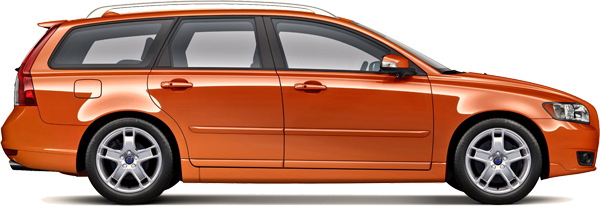
Volvo V50 2.0 (07 - 12) vs. Volvo V50 D5 (08 - 10)
€ 26,400
€ 30,700

€ 26,400
Base Price ⓘBase price of a new vehicle with standard equipment in Germany at market launch.
€ 30,700
ⓘBase price of a new vehicle with standard equipment in Germany at market launch. Price Info

Vehicle Dimensions
The dimensions of the V50 2.0 and the V50 D5 are absolutely identical. Both are 4522 mm long, 1770 mm wide and 1457 mm tall.
V50 2.0
V50 D5
1457

1770
2022
1457
1770
2022
1770 mm
Width
1770 mm
2022 mm
Width Incl. Mirrors
2022 mm
1457 mm
Height
1457 mm

2640
4522
2640
4522
4522 mm
Length
4522 mm
2640 mm
Wheelbase
2640 mm
Vehicle Weight
V50 2.0
V50 D5
1383 kg
Kerb Weight
1516 kg
1890 kg
Gross Vehicle
Weight
Weight
2020 kg
Weight Difference:
133 kg
8.77 %
General
V50 2.0
V50 D5
M
Generation
M
Estate Car
Car Body Style
Estate Car
Unleaded (95 RON)
Fuel Type
Diesel

Front-wheel drive
Drive
Front-wheel drive
5-speed manual transmission
Transmission
6-speed manual transmission
Engine
V50 2.0
V50 D5
Straight-four petrol engine (naturally aspirated engine)
Engine Type
Straight-five diesel engine with two turbochargers (biturbo)
B4204S4
Engine Code
D5244T8
4
Valves
4
4
Cylinders
5
1999 CC
Engine Capacity
2400 CC
143 bhp
at 6000 rpm
Power
178 bhp
at 4000 rpm
V50 2.0
143 bhp
178 bhp
V50 D5
185 NM
at 4500 rpm
Max. Torque
400 NM
at 2000 rpm
V50 2.0
185 NM
400 NM
V50 D5
Performance
V50 2.0
V50 D5
130 mph
Maximum Speed
140 mph
9.6 sec
Acceleration 0 to 62 mph
8 sec
62 mph
62
mph
mph
133 m
0.000 sec

V50 2.0
62 mph
62
mph
mph
111 m
0.000 sec
V50 D5
▶ REPLAY
9.67 kg/bhp
Weight-to-Power Ratio
8.52 kg/bhp
V50 2.0
9.67 kg/bhp
8.52 kg/bhp
V50 D5
Fuel Economy / Emissions
V50 2.0
V50 D5
Fuel Economy
37 mpg
combined
45 mpg
V50 2.0
37 mpg
45 mpg
V50 D5
26 mpg
city
34 mpg
50 mpg
motorway
55 mpg

55 L
Fuel Tank Capacity
60 L
450 mi
Range
592 mi
V50 2.0
450 mi
592 mi
V50 D5
Environmental Impact
144 kWh
Total Energy Consumption
per 100 miles ⓘThe total energy consumption per 100 miles is the amount of energy consumed by a vehicle when burning fuel or using electricity per 100 miles (final energy), and the energy required to produce the appropriate amount of fuel or electricity (primary energy).
per 100 miles ⓘThe total energy consumption per 100 miles is the amount of energy consumed by a vehicle when burning fuel or using electricity per 100 miles (final energy), and the energy required to produce the appropriate amount of fuel or electricity (primary energy).
129.6 kWh
V50 2.0
144 kWh
129.6 kWh
V50 D5
Euro 4 / Euro 5
Emission Standard
Euro 4
176 g/km (NEFZ)
CO2 Emissions
166 g/km (NEFZ)
Practical Convenience
V50 2.0
V50 D5
5
Doors
5
5
No. of Seats
5
507 kg
Maximum Payload
504 kg
417 L
Boot Capacity
417 L


1307 L
Boot Capacity (Seats Down)
1307 L